 We don't sell the fish – we give you the rod.
The Circle
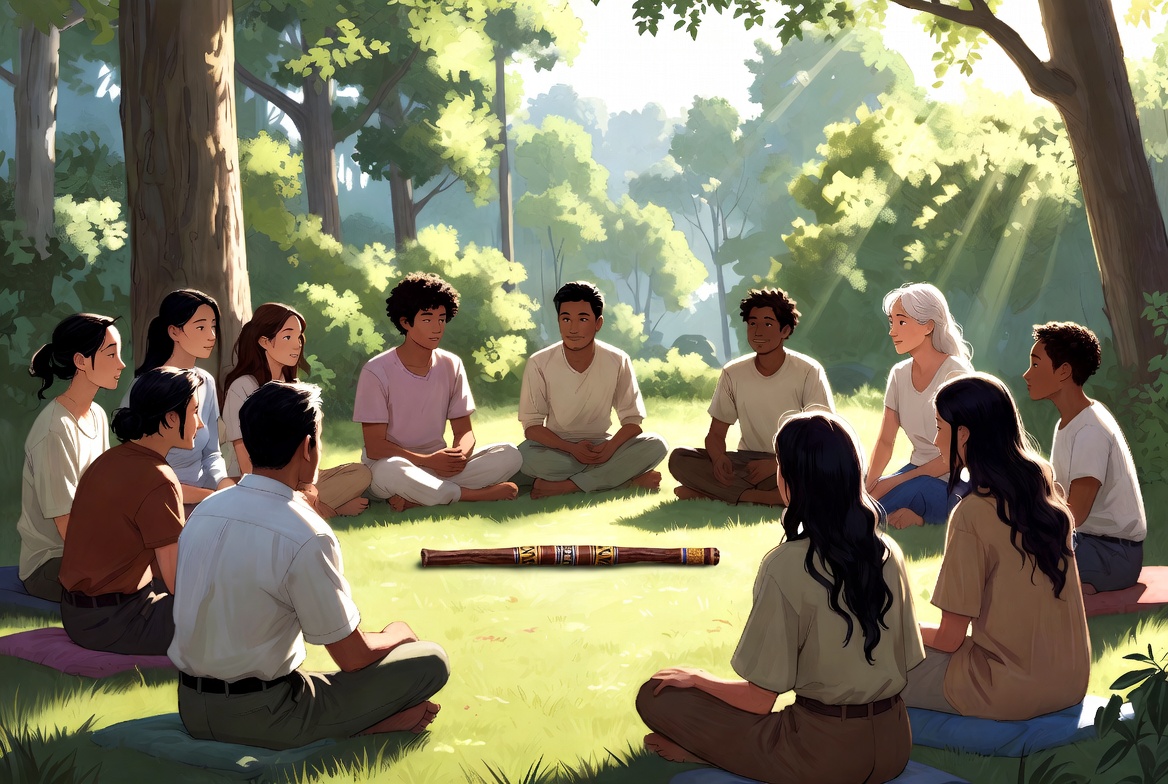
The circle is one of the oldest forms of human community. No beginning, no end, no hierarchy. Every seat is equal. Every voice is heard. This book explains how circles arise, how they are held, and how they carry decisions — without any single person bearing the weight alone. It describes the Food Circle, the Heartsharing Circle, the Talking Stick, the Aho, Consensus and Systemic Consensing. This is not an academic work. It is what a person with sixty years of life experience, many Gatherings, and one empty circle in Berlin has learned. And it is open. The prologue belongs to the author. The rest belongs to you. Bring your experience. Write your chapter. The circle grows larger when everyone takes one step back.
The Circle
An open book — begun by Art (Adam Art Ananda)
Prologue
Yesterday I sat alone in the circle I had created for others.
Nobody came. Not a single person. Many had said they would. Even a friend's daughter who wanted to film it — she didn't show up either.
I posted again: I'm making you all admins. And I'm now writing a book about how we organise these circles at Gatherings, what they're for, and how to facilitate them.
And I wrote: The group is called "You Are Not Alone." Invite people into the circle yourselves. Do it proactively. So you don't end up sitting alone one day, the way I did yesterday.
Maybe it had to be this way. That I sat alone, so that people would recognise: this feels terrible. And that everyone is called to fill the circle — not just the one who called it.
What Is the Circle?
The circle does not arise through planning. It arises through invitation.
I can best explain it through what I know: the Food Circle at a Gathering.
Some people feel hungry — or responsible, or simply feel like cooking together. They sit down in the kitchen, start chopping, cooking, preparing. The whole community. And when they need more hands, they call out:
"Who would like to help?"
That is the first invitation. Quiet. Without pressure. Those with nothing to do hear: I can help here.
Then, when the food is almost ready, comes the second call: Food Circle. It means: one more hour, then there's something to eat.
And then two or three people stand up. They open their arms wide. No announcer, no microphone. Just bodies saying: a circle may form here now.
The circle closes by itself. Around the main fire. And when it is closed, we begin to sing.
We are circling, circling together...
Everyone may bring their own song. We close with a sacred Om — three Oms in a row. We bow. We give thanks to Mother Earth for her abundance. Some do this in silence.
That is the first circle.
Circles Within the Circle
When everyone is eating — when everyone is together and able to listen — that is the moment to announce a new circle.
One says: "I'm organising a Heartsharing Circle. We meet ten minutes after the meal, there and there. Whoever wishes to join is welcome."
And so the Heartsharing Circle arises — the circle of the heart.
Not Hardsharing. Heart-Sharing. The heart shares itself.
There, people may speak about what is on their heart. A conflict with someone in the community. A feeling that is heavy. They don't need to name who. They simply bring the weight into the circle — and the circle carries it.
The principle is known from Ho'oponopono: forgiveness and healing don't arise through solutions, but through being heard.
This is the opposite of social media. There, one names, accuses, makes public. In the Heartsharing Circle, one brings it to the centre — and lets the circle work.
The Principles of the Circle
There are no rules in the circle. But there are principles — principles that everyone essentially already knows. And those who don't, sit down, listen, and do what the others do.
I worked through these principles a year ago with Matti from Estonia, an old friend from the Gathering world, and we tried them out together. Matti's view was: the people coming to Gatherings today barely know these principles anymore. Too many come, and what holds the circle together gets lost — unconsciously, through dilution.
That's why this book exists.
The Talking Stick
Whoever holds the Talking Stick may speak. Everyone else listens.
Even if they say nothing. Especially then. Silence sometimes says more than words.
When they are done, they pass the stick to the left — to the next person.
The facilitator makes sure no one speaks too long. First a gentle sign: start wrapping up. Finally the T with the hands — Timeout. Now really pass it on.
The Aho
When someone says something that resonates, the circle responds: Aho.
It means: I have heard you. Sometimes also agreement. But never contradiction, never pushback, never a no. Only Aho — or silence.
No dislike. No "actually, no."
Newcomers
Anyone who enters a running circle sits to the right of the current speaker. They listen for one full round. Only then may they speak.
This way they know what the topic is. This way they arrive.
The circle grows larger by everyone taking one step back. The facilitator may say: make room so others can sit down.
Leaving the Circle
Even those who leave wait one round. They listen, then they may go.
We have had people who came, said something quickly, and left again. The preachers. The propagandists. They must wait one round before speaking — and one more round before leaving. The circle is not a marketplace.
How the Circle Ends
The circle turns until no one has anything more to say — at minimum one complete round in which everyone is silent.
The facilitator may point this out: "We can sit here for five more days if we want. But we can also close the circle if no one has anything more important to say on the topic. If you have another topic — please open a circle yourself."
Who May Call a Circle?
Anyone.
Who may be facilitator?
Anyone — who has the inner maturity for it. Who knows the principles. Who is willing to serve without leading.
Hardly anyone knows these principles. That is what this book is for.
The Circle in the City
At a Gathering, the circle arises from the context. The fire is already there. The community is already there. People have eaten, have time, have nothing else planned. A circle forms within an hour.
In the city, more is needed.
I learned this in Italy, at a Gathering. There was no Heartsharing Circle — so I called one. Because I was apparently the eldest, at sixty-two. Because the others saw an Elder in me — someone who leads by example.
The circle happened. I received much gratitude that it happened at all.
In Berlin I invited people three days in advance. The energy was gone. People had other things to do, were distracted, said yes and then cancelled. That's not a criticism — that's the city. We are all distracted. If it doesn't happen immediately, it doesn't happen.
Three days' notice in Berlin is like a Food Circle without fire.
The circle in the city needs time. Repetition. Roots. It needs people who invite others themselves — not just the one who called it.
I am the seed. Not the gardener who waters every day.
Consensus — The Circle as a Place of Decision
Circles can be made with three people. That works — you can talk, listen, share. The order matters less.
But a circle only becomes capable of making decisions with seven people.
This is a golden rule. Why seven? Because the weight of the decision is shared across seven shoulders. No single person carries it alone.
Compare that with what we call democracy: a Chancellor carries a decision. One person. How much better it would be if the people carried it. If we had referendums — if the people could say: we want no more wars. We want the conflicts in Gaza, in Ukraine to end. Then the whole people carries it — and politicians can no longer push away the responsibility.
The circle is a model for that. Small, but real.
Circle Size
- 3–6 people: Conversation, exchange, Heartsharing. No formal decision needed.
- 7–13 people: Decision-capable circle. Consensus is possible.
- 14 and more: The circle divides. Two circles of seven, each capable of deciding for itself.
When more than thirteen people arrive, you sort yourselves: who is here? How many are we? Fourteen becomes two circles of seven. Fifteen the same. Each circle stays between seven and thirteen — then it can decide.
How Consensus Works
A topic is brought into the circle. Briefly presented. The circle discusses it — everyone may speak, the Talking Stick goes around. Opinions are gathered, problems named, new ideas introduced.
Then the facilitator says:
"I am now starting the consensus process. If there are still objections, now is your chance to speak."
The stick goes around once. Completely. If the circle is silent — if no one raises an objection — then the consensus is decided.
Not majority. Not vote. Not the loudest wins.
Silence is consent. The circle has spoken.
What to Do With Objections?
If someone has an objection, that is not a problem — it is an invitation.
Objections can be resolved: through explanation, through addition, through new understanding. The circle listens.
When a deeper discussion is needed, there is a special moment: whoever holds the Talking Stick places it on the ground.
That is the sign: the discussion is open.
Now questions may be asked, answers given — but not all at once. Whoever wants to speak signals with a raised finger. Whoever placed the stick on the ground passes the word — to whoever they choose, to whoever signals.
The circle remains ordered. Even in discussion.
When the discussion has served its purpose, someone picks the stick up from the ground. The consensus process continues. The stick moves. And perhaps the objection is now resolved — perhaps not. Then the circle turns another round.
When Consensus Is Not Enough — Systemic Consensing
Sometimes there are multiple ideas, multiple paths, multiple possibilities. And no clear silence. Then another method can be brought into the circle: Systemic Consensing.
The difference from a normal vote is essential: one does not ask who is for something. One asks who has resistance to it.
Here is how it works:
All options are listed — including the status quo, meaning "we do nothing." Then each person in the circle rates each proposal on a scale of 0 to 7 — or 0 to 10, depending on what the circle agrees.
- 0 means: No resistance. I can support this.
- 7 means: Strong resistance. I reject this.
The points are added up. The option with the lowest total — meaning the least resistance — is decided.
Not the loudest proposal wins. Not the one from the eldest. But the one everyone can best live with.
That is not compromise. That is consensus.
Invitation
This book is open.
The prologue is mine. The principles belong to the circle. Everything else belongs to you.
Have you experienced a circle — in your city, your community, your family? Have you called one that worked? Or one where nobody came?
Bring it into the circle of this book.
Write your chapter. Tell how it was. What worked. What didn't. What you learned.
The circle grows larger when everyone takes one step back.
Aho. 🌱
"The Circle" is a CrowdBook — an open, collaborative book on the CrowdWare platform. Begun by Art (Adam Art Ananda), Lutherstadt Wittenberg, April 2026.
No published chapters yet.